

















Post by: Glennman
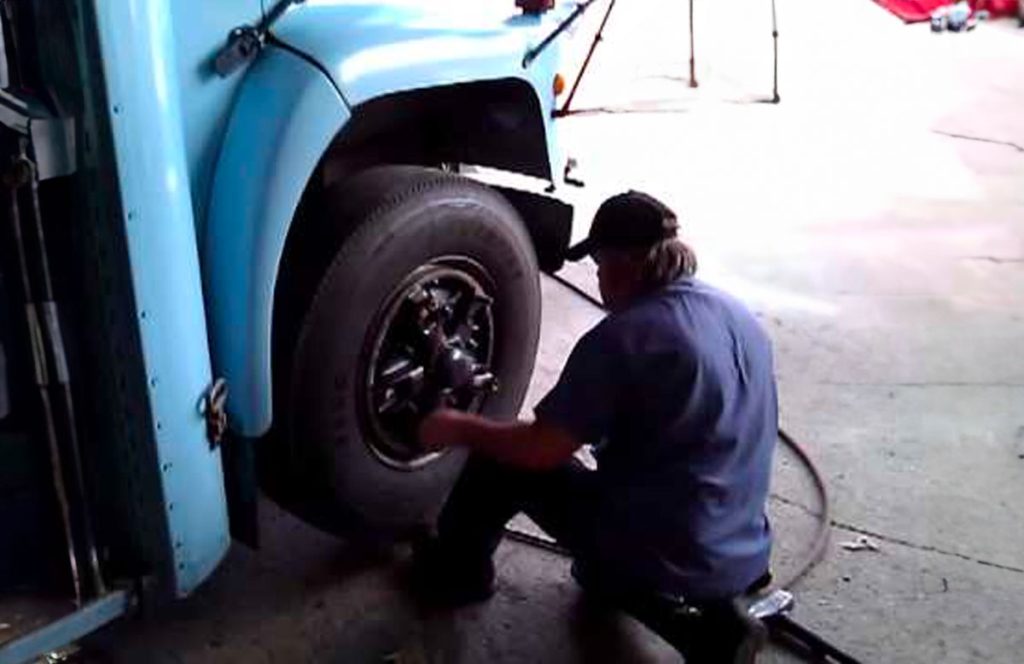
I’m planning on installing quick-disconnect connections for airing up tires. At the rear of the bus, there is an air chuck inlet at the bottom of the air dryer, and at the front, there is an air chuck inlet at the small air tank under the driver’s seat. Would those be good places to install air chucks for hose connections? I’d like to install one at the front and one at the rear for convenience. Any ideas on that?





Post by: wind trader
That’s a great idea as it is always a pain to drag a 50’ hose around the bus from my compressor that is in the engine bay. Please keep us posted.
Post by: luvrbus
There should be an air connection on the passenger side rear door. You need to plumb close to a compressor at the rear, my bus had a connection at the auxiliary tank up front too, but it had a one-way check valve and was regulated; It was useless except for a tow truck to connect.
Post by: Dave5Cs
Glen, the front outlet is to release the air brakes like Clifford says for a tow truck. For the outlet in the rear, I hook a hose to mine and leave it halfway down in the bay ceiling with a tee. I have a hose going both ways with an NPT fitting on the ends. That way when I want to fill tires, I just plug in a short 12-foot hose, and I can reach any tire.
Post by: Glennman
Sounds like I need to stick with a long hose and one connection near the compressor. There’s too much regulating going on with the systems at the front. I’ll take another look at it this weekend. Thanks, everyone!
Post by: luvrbus
I always ran the same pressure in all eight tires, so I had a preset regulator at the rear and used a clamp on an air chuck and never worried about the pressure, and I didn’t need to keep checking the pressure on each tire.
Post by: Glennman
Great idea luvrbus! Thanks for that!
Post by: luvrbus
You can always add a gauge at the regulator if you are one that uses different setting on the other axles. I set mine once and forgot about it. Checking tire pressure on a bus is time-consuming.
Post by: Dave5Cs
Good idea thanks. I have to stop when airing up because it hurts my thumb.
Post by: Jim Blackwood
Great idea. I have a regulator I can use with the air hose and a clip-on air chuck.
Post by: luvrbus
I don’t run my engine here at the shop for airing up my tires. I plug the RV into shop air. I still use the same hookup on the RV, just a different air supply to keep from burning fuel.
Post by: windtrader
Clifford’s suggestion is great when one pressure is desired. From the recent discussion on tire pressure, it seems there are three different pressures required to properly inflate tires: steers, drives, and tag. Each carries a different weight so three different pressures.
Post by: dtcerrato
A Tire Pressure Monitoring System (TPMS) is your friend in that it lessens the frequency of the need to check tire pressure.
Post by: luvrbus
Bus conversion people are about the only group that follow those tire inflation guidelines. Commercial drivers air their tires up to 10 to 15 lbs. under max inflation, then they drive off. Can you see a trucker changing their air pressures on 18 tires? Do you weigh your automobile front and rear?
Post by: windtrader
I just brought out other ongoing discussions about tire pressure – per axle, etc. The only tire pressure I am changing is lowering pressure all around to 85-90 lbs., and then I am done. The TPMS is my friend while on the road. What I found interesting is the tire pressure discussion did not get into how much the pressure changes while driving and which direction the sun is shining.
Post by: luvrbus
Quote from: dtcerrato
A Tire Pressure Monitoring System (TPMS) is your friend in that it lessens the frequency of the need to check tire pressure.
They are ugly on a bus. The Mexican buses have a self-airing system that keeps the tires at a preset pressure. The military Humvees use the same type of system.
You see a lot of trucks and buses with the system to keep the duals with equal pressure. The downfall of those systems which keep the duals with equal pressure is that if one tire goes flat both tires are flat in a few minutes.
My TPMS was tied to the Silverleaf. When the TPMS checked the pressure in the mornings and found a flat tire it would not let you engage the Allison to move. That only happened to me once. After two hours of looking things over and finally reading the manual as a last resort I did figure it out.
BUT WAIT…THERE’S MORE!!! Click on the link below to read additional comments that were added after we published this post. There are many more comments with even more information that may be useful to you and your bus.
Forum content extracted by Phil Lyons, our Chief Forum Moderator. To read the rest of this discussion in the Forum, click this link:
https://www.busconversionmagazine.com/forum/index.php?topic=36905.0
Discussions like this take place on a daily basis in the Bus Conversion Magazine Online Discussion Forum.
To read them go to:
https://www.busconversionmagazine.com/forum/index.php
Anyone can read the discussion board, but to get the most out of the Forum you need to join by clicking the “register” link above the login box in the upper left section of the Forum page.
Registration is free and once registered you will be able to view all the avail-able discussion boards, view images, lookup and contact other members, reply to other members, share your own experiences for others to learn from, and most importantly, post your own questions.