

















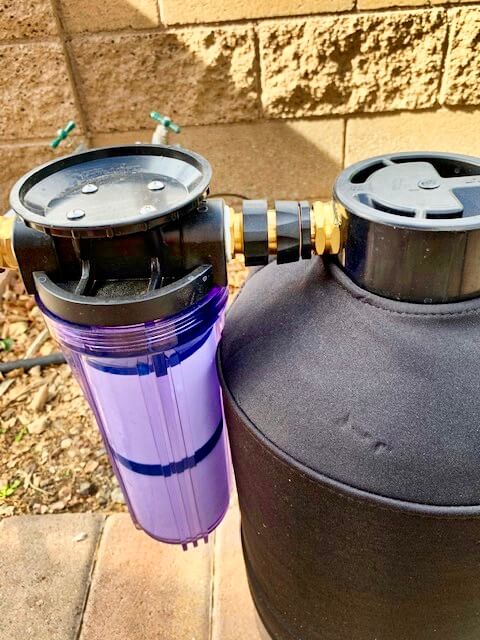

If you travel a lot in the Southern tier of the US or into Mexico frequently, you will often encounter water that is very hard, may have an off-taste, or contain sediments that you don’t want in the water system in your bus. Several manufacturers make portable water softeners, but most are awkward to set up and regenerate.






They also can be quite heavy when full of water and therefore hard to store while driving. Separate water filters are also readily available but most won’t stand up on their own and can be fussy to hook together with the water softener to make a complete system.
I recently found one that is a nicely integrated full system that can be set up quickly, stands upright by itself, has 3/4” fittings for good flow, allows the addition of solid brass quick disconnects to snap it together into a single unit, and makes regeneration of the water softener beads nearly automatic. It is sold on Amazon under the brand name “Pro+Aqua”.
A second part, called “Softener Regeneration Kit and Water Filter,” contains a two-stage filter (sediment and activated charcoal) that fits into a single 10” filter canister. Separately I purchased solid brass quick disconnect fittings for everything, including male and female plugs, so I didn’t have to worry about water spills during set up or storage.
When it is time to regenerate the 16,000 grains of water softener resin, simply remove the two-part filter, put two standard two-pound round boxes of common table salt found in any grocery store into the canister housing, and screw it back onto the base. An included small tube connects the output from this canister to the output side of the water softener. The quick disconnects make this simple and fast to do.


Run fresh water through the canister to make a salt brine at a rate that will allow a pencil-sized stream of salt brine to pass through the water softener and out the input side of the softener. This back flush will make sure all the softening resins are exposed to the salt brine where the chemical reaction between the salt brine and the resin beads will flush all the hard water residue out of the softener and make it ready for another round of softening. Run the pencil-size stream for 15 to 20 minutes and then turn the water on full blast for about 5 minutes to flush all the salt out of the softener and the canister.
Storage area in the bay with and without the water softener and cartridge pre-filter. My folding Brompton bicycles fit between the four portable solar panels (the black units forward) and the water softener on the shelf so nothing shifts around while going down the road.

Now, all that is required is to unsnap the small tube quick disconnects, put the two-part filter back in the canister, and use the quick disconnects to remount the canister with the two-stage filter back on the input side of the water softener. Note that the length of the quick disconnects is exactly what is needed to securely attach the canister to the softener without stress on either component. Slick, fast, and tidy with no awkward extra runs of hose to leak or worry about.
One neat feature of this setup is the water softener is shorter than other units of the same capacity so it is easier to find room to store it while traveling. And, the fact that the canister pre-filter fits so snugly against the side of the softener allows you to leave them connected during storage without having to dump out the water unless you want to.
I rigged up both male and female caps with the same quick disconnects so I can securely seal everything up during transport. That sure beats tipping the heavy water softener over to drain out the water before putting it into the bay. I built a simple platform that the softener and pre-filter sit on in the forward storage compartment on the driver’s side of my coach. Full of water the units weigh over 50 pounds so making storage easy and fast is important!